

広島大学旧生体システム論研究室(辻・曽研究グループ)では,長年にわたって乳幼児自発運動の解析・評価に関する研究に取り組んでおり,島谷 康司先生(県立広島大学 教授),土居 裕和先生(長岡技術科学大学 教授),古居 彬先生(広島大学 准教授)らとともに,科学研究費補助金 挑戦的研究(開拓)と国際共同研究加速基金(海外連携研究)を実施しています.
https://fka-bsys.hiroshima-u.ac.jp/news/17722
https://fka-bsys.hiroshima-u.ac.jp/news/17822
今回新たに,ソルボンヌ大学との共同研究の成果をまとめた論文が掲載されました.この論文誌”Scientific Reports”はWeb of Scienceの”MULTIDISCIPLINARY SCIENCES”というカテゴリーのQ1ジャーナル(Journal Impact FactorとJournal Citation Indicatorによるランキング)です.おめでとうございます!
今後も本研究チームとともに研究を継続し,さらなる研究成果につなげていければと思っています.
————————————————————————-
Manual and automated assessments of General Movements in neonates are associated with early autism risk at 18 months
Annik BEAULIEU, Catherine SAINT-GEORGES, Isabelle HABGARTH, Maeva DA CUNHA, Pessia GRYWAC, Muriel CHAUVET, Marie-Christine LAZNIK, Orna LEVENACAB, Hugues PELLERIN, Salvatore ANZALONE, Giulio BERTAMINI, David COHEN, Midori YAMAMOTO, Koji SHIMATANI, Kenichi SAKURAI, Chisato
MORI, Akira FURUI, Toshio TSUJI, Xavier BENAROUS, and Hirokazu DOI
Scientific Reports, https://doi.org/10.1038/s41598-025-34525-y, Published: 19 January 2026.(early access, SCIE, IF=3.9)
URL: https://www.nature.com/articles/s41598-025-34525-y
<論文内容>
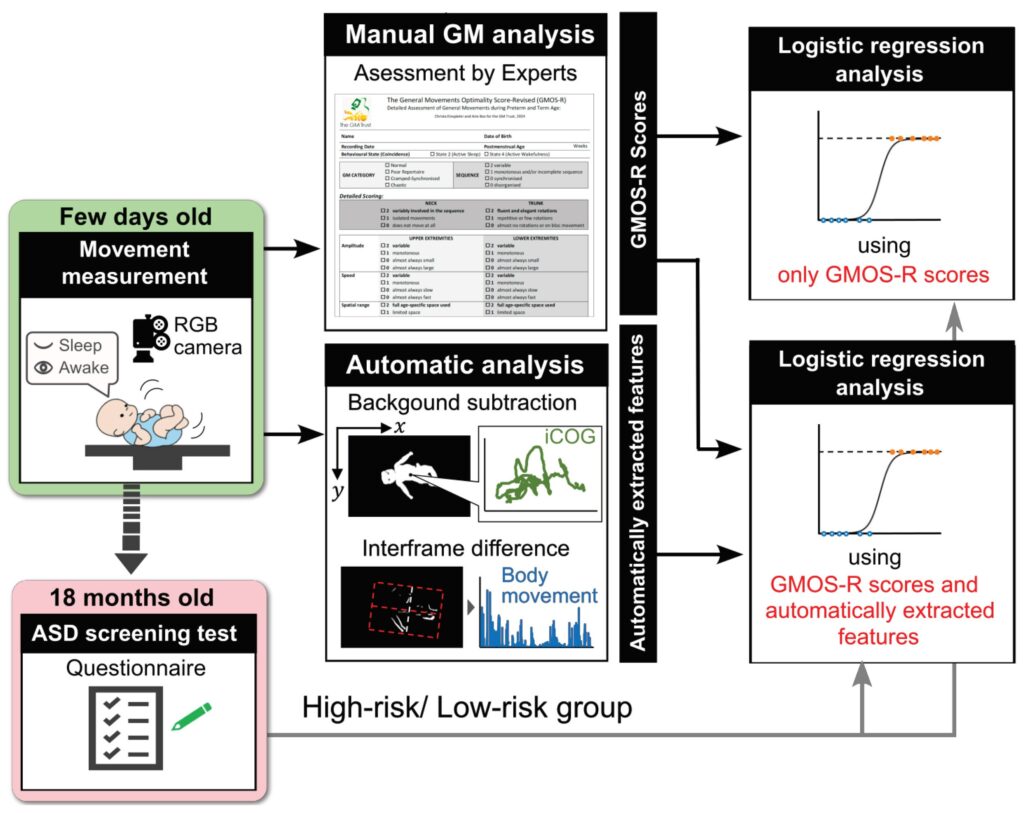
General movements (GMs) refer to infants’ spontaneous motor activities before the emergence of voluntary motor activity. Atypical GMs in neonates have been regarded as a marker of poor neurodevelopmental outcomes, with preliminary findings in autism. To examine the relation between atypical GMs in neonates and autism risk, videos of neonates (n=76) extracted from a Japanese birth cohort were retrospectively exploited. A manual assessment of GMs was completed using the General Movement Assessment Optimality Score (GMOS-R) rated by professionals blinded from all clinical information. An automated assessment of several features of neonates’ motor activity was also conducted using videos of neonates. Outcome measures were the M-CHAT score at 18 months to document autistic risk status and the Strengths and Difficulties Questionnaire (SDQ) at four years to measure non-autistic general psychopathology. The GMOS-R total score and subscores significantly predicted the autistic risk status according to M-CHAT, but not the general psychopathological status according to SDQ. In the manual assessment of GM, “Global poorness of motion” was the most informative feature in predicting ASD risk. The classification performance systematically increased by the addition of the automatically extracted features based on the Loglikelihood tests, while DeLong tests for comparison of AUC failed to reach statistical significance. Such improvement came mainly from incorporating information about the imbalance in motion strength between the upper and the lower limbs, and was more marked for awake babies. This finding confirms the relevance of considering abnormal motor patterns in neonates as an early marker of autistic risk.
General movements(GM)とは、随意運動が出現する前の乳児の自発的な運動活動を指す.新生児における非典型的なGMは神経発達不良の指標とされ,自閉症との関連が示唆されている.本研究では新生児の非典型的なGMと自閉症リスクの関係を検証するため,日本の出生コホートから抽出した新生児(n=76)の動画を遡及的に分析した.運動評価は,臨床情報を一切知らない専門家による「一般運動評価最適性スコア(GMOS-R)」を用いた手動評価で実施した。新生児の運動活動に関する複数の特徴については,動画を用いた自動評価も実施した.アウトカム指標として,自閉症リスク状態を評価する18ヶ月時点のM-CHATスコア,および非自閉症の一般的な精神病理を測定する4歳時点のStrengths and Difficulties Questionnaire(SDQ)を採用した.GMOS-Rの総得点および部分得点は,M-CHATに基づく自閉症リスク状態を有意に予測したが,SDQに基づく一般精神病理学的状態は予測しなかった.GMの手動評価において,「運動の全体的な貧弱さ」がASDリスク予測において最も情報量の多い特徴であった.対数尤度検定に基づく自動抽出特徴量の追加により分類性能は系統的に向上したが,AUC比較のためのデロング検定では統計的有意性に達しなかった.この改善は主に上下肢間の運動強度不均衡情報の組み込みによるもので,覚醒状態の乳児でより顕著であった.本知見は,新生児期の異常運動パターンを自閉症リスクの早期マーカーとして考慮することの妥当性を裏付けるものである.
————————————————————————-